Posts

Showing posts with the label martial arts

Listening

Image
When I meditate, it's pretty hard to keep from getting lost in my thoughts. One thing that helps a lot is to try very hard to just listen . I imagine that there's some very subtle sound I'm trying to hear, just barely at the limit of my ability to hear it. Sometimes I can become very aware and attentive. It struck me that this is a great thing to practice in general. So often, when playing music with others, or by myself, I'm generating thoughts, judgments, desires, remembering what just happened. It would be so much better if I could just listen. In my conversations with others, I've found I do the same thing: I start to generate a reply, or a judgment, or a reference, and suddenly I'm not listening anymore.  I think the analogy extends easily to the martial arts, but in a more metaphoric way, in that I can learn to be more attentive to what is happening with the other person, instead of myself. It's not easy, but maybe with practice, I'll ge...
Using Rhythm to Create "Lift"

Image
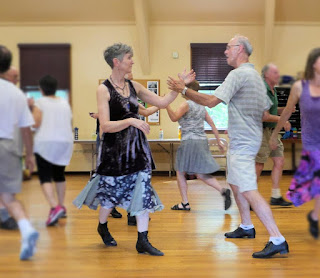
Photo by Doug Heacock Learning to play the violin has been great for me, because it brings another perspective to things I experience in aikido (and vice versa). One of these is how you can use rhythm to move peoples' bodies. Using rhythm to create "lift"in music I play a lot of traditional music - Irish, American, Scottish, English, French Canadian, and more. Much of the traditional music repertoire is written for dancers. Of course, dancers need to know where the beat is. But musicians can also help make the dancing more fun by adding something called "lift." "Lift" makes the music feel lighter and more energetic. Some people do this unconsciously, but sometimes you have to focus on what you're doing or not doing to get it right. It might mean emphasizing the up-beat, or lightening up certain repeated notes, or even by creating spaces or rests. The most important point is that it's dance music and it should make you feel like dancing...

Excuse Me, But You're Doing It Wrong....7 (no- 9!) Reasons NOT To Correct Your Partner in Aikido

Image
In Aikido practice,  I often see a less experienced student "correct" an experienced student. I'm sure these people genuinely feel they're offering something of value. But it's inappropriate, incorrect and detrimental to your own progress to correct people who've been practicing longer than you. A while ago someone asked  Cecelia Ricciotti  (7th dan), "What do I do if I'm working with someone who has more experience, and they just plain out-and-out are doing it wrong?" "Well," she said, "You have to make a decision: Do you want to take on the role of teacher? Or do you want to continue to be a student?" 7 Reasons Not To Correct Your (More Experienced) Partner In Aikido Respecting each other is one of the most important parts of our practice. You demonstrate respect for someone who has more training than you by listening to what they have to teach you. Especially if you disagree with them, it's a great opportunity...

Top Practicing Techniques of Great Musicians (and Great Martial Artists)

Image
I dislike the concept of  listicles ,  as readers may know , but I ran across a nice blog post called  8 Things Top Practicers Do Differently . It's a brief summary of some research  done in 2009. The principles translate (as they so often do) to martial arts practice as well. You can read the post , ("No! I'm too busy! Just tell me what it says!"), but here's my takeaway ("Thanks!"). A group of piano students were set a brief excerpt of music, given the same amount of time to practice it and had to come back the next day to play it. Their performances were evaluated for correctness (right notes, right rhythm) and quality (tone, character, expressiveness). Practice Strategies of the Winners Since most people can only remember three things , here is a distillation of a distillation of the winning strategies: Whenever you practice, practice with focus and attentiveness . As we say in Kokikai Aikido, with "mind and body coordinated....

Making it Look Easy

Image
I was in a guitar workshop once with Matt Heaton (don't ask me why I was in a guitar workshop since I don't play guitar...). He was talking about doing a really fast jig strumming technique, and said that the most important thing is to relax - think of making it look easy. He joked that of course, when you are watching your favorite musician play some incredible riff, the one thing you always think is, "And, he/she makes it look sooo difficult!" Of course not! The great players make it look so easy! But that's because the great players, athletes, and martial artists are able to relax when they do whatever it is that makes them great. And when they can relax their hands, face, shoulders, neck and back, they actually can do whatever they are doing: faster, more effectively, and more beautifully.

Kokikai Aikido Winter Camp - Which Classes to Attend?

Image
Kokikai Aikido Winter Camp is approaching once again. This year (as always) many students will be attending camp for the first time. Many wonder, "Should I attend all of camp? If not, which classes will be the best to attend ?" Often they hear that some of the classes are "mostly testing" and since those will be the "boring" ones, they choose others. This is a beginner's mistake! Of course, the opportunity to practice under Sensei's teaching, with people we may not usually practice with, is certainly one of the joys of camp. But do not underestimate the value of watching testing! Here's why: 1. Watching testing trains your eye . Sensei says it is very important to "develop your eye," - to learn to distinguish what is real from what is fake, what is relaxed from what is stiff or tense.  You will learn to look for small details such as how nage's posture looks at the end of the throw,  or look for relaxed hands and face -  a...

Keep One Point

Image
I've been slowly but surely writing of a series posts devoted to each of the  four basic principles of Kokikai Aikido . One of these is Keep One Point to Develop Calmness. We spend about 90 minutes in each aikido class, and most students practice once or twice a week - only a small proportion of the of hours we are awake each week. It may be plenty of time to spend doing a demanding physical exercise, but we need to spend more time working on the underlying principles for them to become second nature in our bodies. Fortunately, all of the basic principles are easily practiced at any time, not just in class. We can easily practice finding and keeping One Point while off the mat, and test the results when we're back on the mat. What Is One Point? One Point is a concept closely related to your center of balance. Centuries ago martial artists discovered that if the mind is focused on keeping this point low, one becomes stronger and harder to move. In Kokikai, we first...

Powerbreathe

Image
Oh, <sigh...> I tell so many people about the benefits of a simple daily 10-minute breathing practice . It helps calm the nervous system, help people better deal with pain, builds endurance, strengthens the heart, and has many medical benefits: how many people suffer from asthma, COPD and other breathing related disorders? It can be practiced anywhere, by anyone, without special equipment. And, best of all, it's free . Most of the time people nod and smile, and do nothing. I just discovered the Powerbreathe website. They have manufactured a device and devised a program that they claim helps improve lung capacity, with all the benefits I mentioned above. Please read all the convincing arguments on this site. And then know that these same results are possible without the device. No one has done the studies, because no one makes money from a simple breathing exercise, so I can't make any medical claim. However, martial artists, yogis, alternative health practitioners...

How to Stop Students from Arriving Late

Image
White Rabbit - ill. John Tenniel One day I asked a yoga teacher if she could try to finish class on time. I had often been late for a regular appointment because I had expected that class would end on schedule. The teacher gave me a noncommittal answer, because, she said, people were still arriving for class one minute before class was to start. It's thoughtless of students to arrive late (and I'm as guilty as anyone else here), but they will slip into the habit if they know the class will start late, and a vicious cycle begins. When I began practicing aikido our dojo had this problem in spades. The teacher arrived either barely on time or 5-10 minutes late, and even when on time he would chat and dawdle until class often started as many as 20 minutes late. As time passed the students realized there was no point in arriving on time, so they started arriving later. Many students became frustrated, particularly as class that was scheduled to finish at 9:30 pm now stretch...

Advice from Chick Corea on Practicing

Image
Chick Corea, the 18-time Grammy winning keyboard legend, offers some advice to a fan who asked about managing practice time. I think this advice applies to all types of practice. Here it is: To learn how to prepare properly or practice properly, to make advances in one's technique, or knowledge at the instrument, or music in general, is a really important thing.  The main thing that I can see about practicing—and it's also true about playing—is that the very basis of practicing, and knowing "when" and "how" and all of that, stems from first having an intention to advance, an intention to improve. An intention to take a certain challenge, or a certain piece of music or a certain phrase, or any particular thing that you think of, and then you have an idea that you would like to improve it, and you also have an idea of how it probably would sound, when it sounded right.  And this is another real important aspect—how you know when you've arrived, ...

Gently and Friendly

Image
I work for a marketing company, and one of our clients is owned by a Japanese firm. The Japanese owners recently introduced a new marketing tagline: "Gently and Friendly." The American division decided that this tagline, although it might be suitable for Japanese audiences, did not convey the way that they were driving, aggressive and technology-focused, and so they are using a different tagline. I was thinking about this issue on the way home from teaching the first aikido class of the semester. Maybe this "tagline" would not be suitable for most martial arts, because it doesn't convey the driving, aggressive, "win at all costs" attitude that they want to portray. But perhaps "gently and friendly" would work for  Kokikai Aikido ? Don't get me wrong, I don't think we need a tagline!  But it's fun to think through the idea... So,"gently" might represent the way we use less effort, staying as relaxed as possible.  ...

Basho and Musashi

I once read a story about the Musashi , and  Basho . This story must be apocryphal as they did not live at the same time, but I think of it often in relation to martial arts practice. Musashi was a samurai with a deep interest in Zen Buddhism, and Basho was a poet with a samurai background - both were also known as great travelers. So, according to the story they met on their travels, and they sat down to talk and rest. As they sat in the forest, they saw a mamushi , or Japanese pit viper, sliding toward them. Neither moved. The viper approached Musashi, and, somehow sensing danger, stopped and changed directions. When the viper approached Basho, however, it slithered over his feet as if he were part of the forest floor. Sometimes the objective is achieved by not having a fighting attitude.

Taking Responsibility for Your Practice

Image
Everyone comes to class to learn something. Consciously or unconsciously , they place the burden of teaching on their instructor. In aikido , for example, many students believe that there is some set of “correct” techniques that the teacher will “impart” to them. They think that a good teacher will impart the techniques more correctly, and, therefore, if they don’t learn it’s the teacher’s fault. This is 100% incorrect . The person who is responsible for what you learn is you . The instructor can provide help and encouragement but you must give your full attention to your practice in order to progress. Maruyama Sensei provides an amazing example and he is a great teacher. He has taught a lineage of students who are also wonderful teachers. But they all understand that even when we have a great teacher, our learning must come from within. When Sensei says, “Find out for yourself,” or asks, “Which is better?” he is encouraging us to take responsibility for our own learning. When I ...

Misconceptions about Aikido

Image
When I mention to others that I teach aikido I get a variety of reactions, most of which are based on misconceptions. Some seem very confused, as if they can't put this idea together with the person they know. Perhaps it's because most people think of martial artists as young, muscular, and male, and I am none of these. Yet I have been practicing Kokikai Aikido for over 16 years and have been teaching for 8 years. Misconception 1 . I bet you could kick my ass. Reality: It would never occur to me. In practicing aikido I have learned not to react to anything that is not a threat. Misconception 2 . It doesn't make sense for a person who is committed to more peaceful interaction to be involved in a martial art. Reality:  Aikido is an ethical form of self-defense. In Kokikai Aikido, we practice that the greater the threat, the more we relax. This enables us an infinite amount of flexibility, even right in the middle of the response to an attack. I've heard this story...