Posts

Showing posts with the label music

Five Steps to Achieving the Impossible

Image
I recently decided to learn a song . It’s one that’s typical of a certain Irish style of singing which is very wordy, often humorous, with lots of alliteration and  internal rhymes , and is sung quite fast. I’ve always been crappy at memorizing pretty much anything. For all that people call me talented and artistic, poetry reading and acting were never options for me. My aikido students  know that I can’t even remember the four basic principles: I get to three and then get stuck.  Memorizing a nine-verse song with long words that have to be exactly right or the rhymes don’t work, and no room for breathe or think? Out of the question. But I wanted to. And I was armed with some new tools for mastery that I've been using really successfully in my aikido and music practice.  So here’s what I did: Start with absolute confidence that it was possible .  Practice S-L-O-W-L-Y .  I have a cool program called Amazing Slow Downer . I set it up in my car t...
Using Rhythm to Create "Lift"

Image
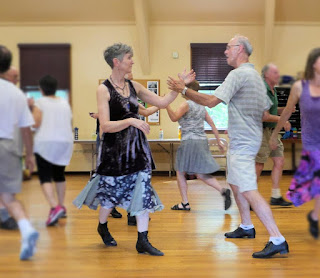
Photo by Doug Heacock Learning to play the violin has been great for me, because it brings another perspective to things I experience in aikido (and vice versa). One of these is how you can use rhythm to move peoples' bodies. Using rhythm to create "lift"in music I play a lot of traditional music - Irish, American, Scottish, English, French Canadian, and more. Much of the traditional music repertoire is written for dancers. Of course, dancers need to know where the beat is. But musicians can also help make the dancing more fun by adding something called "lift." "Lift" makes the music feel lighter and more energetic. Some people do this unconsciously, but sometimes you have to focus on what you're doing or not doing to get it right. It might mean emphasizing the up-beat, or lightening up certain repeated notes, or even by creating spaces or rests. The most important point is that it's dance music and it should make you feel like dancing...

No, no, no, no.

Image
Photo by Bill O'Neill In August I played at a fiddle contest. No, I didn't win. My goal was to make it through both tunes without stopping. And I achieved my goal. After all, I've only been playing for a couple of years. In fact, before I played, I said something to the effect of: "I've only been playing for two and a half years - I'm saying this not to get your pity, but to tell you that if you want to try something that seems really hard, even at an 'advanced age,' go for it!" After the contest was over, the musicians were starting a little jam session. Someone came up to me and told me how much what I said had inspired him. He said, "I really want to play again. I played when I was in high school, and everyone really thought I was good then." "Well, why don't you come and play with us now? Someone will loan you a violin!" "No, no, no, I couldn't do that, they would laugh at me!" "OK. If y...

Plays Well With Others

Image
I often play music in "jam" or "session" situations where we play tunes that some people know, others may be trying to pick up by ear. I've noticed that musicians react to the group setting in different ways. Less experienced players often seem to be performing for the other musicians, showing off what they know, playing difficult stuff and playing it fast. They don't notice if anyone else is joining in. More experienced players, while definitely trying to play their best, also work to fit in - for example, they try to make sure they're playing in rhythm with everyone in the room. They'll play quietly at times and leave space so others (especially singers) can be heard. They may play very simply to help others follow, or choose simple tunes so that more people can participate. My first jazz music teacher used to say that music was like a conversation. I see more and more ways that he was right.

Sooner, Not Faster

Image
I'm a pianist and I practice the martial art of  Kokikai Aikido . Lately I've been working on speeding up. Part I - Music Usually I'll practice a tune till it sounds great when I play it slowly. Then I turn up the metronome. As soon as I do that I can feel my shoulders getting tense, I can't hit any of the notes, I forget what I'm doing and everything sounds like h*ll. I've come to realize that what's holding me up is not lack of technical ability, but my own mind. My brain is stuck in "slow mode." I'm used to hearing the music slower in my head. So when I play fast, it feels like I'm always trying to catch up. My brain is a half step behind what my fingers are doing. I realized that instead of just going "faster," I have to think "sooner." I have to think ahead , and then I'll be ready to move my fingers at the right time. I can tell you that takes a lot of attention to do that. My brain constantly wa...

You Have To Practice Taking a Rest

Image
Today my piano teacher (who is awesome) was trying to help me improve my mediocre improvisation skills. We were talking about the fact that the improv sounds much better when you leave intentional gaps, spaces, or pauses in the music. They add a rhythmic component, they focus the listener's attention on what they heard, prepare them for what they're about to hear. They help me gather my thoughts before I come up with more ideas, and they just make the whole thing sound better. But even though I know this, I don't do it. "You have to practice it," Dave said. " You have to practice taking a rest ." I wrote that down.... .....in BIG LETTERS.

Simple Ideas, Challenging Practice

Image
Recently after an aikido seminar, a bunch of us convened at a local restaurant with Sensei . As I was chatting with someone next to me I looked up, and Sensei met my eye across the table. "Judy, what do you think of Sensei this time?"  I laughed and said, "Sensei, you're even more amazing than before !" (First principle of ethical speech : Is it true? Yes. He was definitely more amazing.) Somewhat tongue in cheek, since the answer is the point of all his teaching, I asked him, "Sensei, how do you do it ?" He pulled up his sleeve to show me (for probably the 100 th time) the way he can keep his forearm and biceps totally slack and soft. And he said, (for probably the 1,000,000 th time,) "Judy: the secret is, I never use muscle !" A friend of mine once lamented, "Why is it you have to be in therapy for years before you hear the thing the therapist has been telling you ever since the first day?" Looking back over my po...

Creating More With Less

Image
I recently attended a violin workshop with the renowned Irish fiddler, Kevin Burke  (who's actually English and lives in Oregon). He was talking about adding rhythm to the music with certain notes that are repeated on the beat. Below is a snippet from Walsh's Hornpipe . Even if you don't read music, you can see that the same note is repeated rhythmically. (I made those notes red.) When you listen Kevin play it, (it's very the first tune on this video ,) those notes really stand out. How to Make More with Less Kevin said that to give this tune more rhythm, you have to play these repeated notes more lightly. He said that most people make the mistake of playing them heavily, and then they sense the tune doesn't have enough of a rhythmic feel, so they play them even more heavily, and so on and so on. Man, does that sound like aikido.

My Sneaky Scheme

Image
Have you ever had this happen? You try to persuade someone of something, and they just won't listen. but three days later they read it in the news and it's as if they came up with the idea themselves - they tell you about their great idea. It's frustrating! But it's understandable. Sometimes we have a hard time grasping a new idea when it's presented "straight on." It's like it has to come at us from a different angle, and then we have to absorb it as our own. I think it's like that with my practice. I have to absorb new ideas, think about them, and make them my own. Sometimes I write about aikido and sometimes I write about music. Most of the time I think the concepts I write about relate to both, (though I don't always mention it). You may wonder, "What audience is she writing for, that practices aikido and music? That can't be more than 100 people on the planet!" Here's my sneaky scheme: Both music and aikido a...

Making Time for Play

Image
I have to work hard to carve out time for practicing, and sometimes I lose track of the fact that I play music because I love playing. I don't know how it is for other people, but, especially when I'm playing alone at home, I have to remind myself sometimes to just play . Play for fun. Play for playing's sake. Sit on the front porch with my instrument and mess around. It makes me feel guilty to have free time and not use it to practice. So I tell myself that, yes, it's fun, but it will also help me improve. That makes it OK. Maybe I should just pay more attention to my cat...

Two Ways to Practice

Image
I've been thinking lately about two ways to practice. Of course there are many ways to think about practice, but looking at things this way has helped me lately. I'll stick with a music analogy but it's easy to see how this applies to aikido, or to other things. Technique The goal of technique practice is to learn to do something correctly. Often that "something" is just a small element of the whole.  In this type of practice you usually stop when you make a mistake, fix the mistake, and try again. Or you may continue to work in rhythm without stopping, but you may slow down or simplify in some way until you can "get it right." Getting it right means not just the outer form: playing the notes or doing the correct movements, but the inner as well: remaining relaxed, staying focused, keeping good posture. Playing Through By "playing through" I mean playing the entire tune (or a significant section), keeping the beat, and not stopping...

From Connection - to Detatchment - to Connection

Image
A Zen writer once addressed the criticism that Zen Buddhists are too focused on being detached. A student asked: "Isn't Zen all about being 'one with everything'? So why are Zennies always talking about staying detached?" The author responded that there was a progression in which the student at first has an unhealthy connection to their emotions and sensations, and has to learn to detach from this connection. But that eventually the student comes back to truly comprehending the unity of everything. It sounded like a bunch of gobbledygook to me. The other day my piano teacher started to talk about those moments in playing when you lose your ego, and it's "as if the music is playing you."  I got a little glimmer of what he was talking about, and I even saw the relationship to the idea of being connected vs. being detached. So, let's see if I can explain it in a way that even I can understand. Connection Most people are used to lettin...

Making it Look Easy

Image
I was in a guitar workshop once with Matt Heaton (don't ask me why I was in a guitar workshop since I don't play guitar...). He was talking about doing a really fast jig strumming technique, and said that the most important thing is to relax - think of making it look easy. He joked that of course, when you are watching your favorite musician play some incredible riff, the one thing you always think is, "And, he/she makes it look sooo difficult!" Of course not! The great players make it look so easy! But that's because the great players, athletes, and martial artists are able to relax when they do whatever it is that makes them great. And when they can relax their hands, face, shoulders, neck and back, they actually can do whatever they are doing: faster, more effectively, and more beautifully.

Schooling my Face

Image
"Stupid Face" can be very helpful when disarming an attacker.  I'm very good at it. Here's why I'm practicing "schooling my face": Head Cues When playing together, musicians often give cues, like: "Yep, we're going to change tunes," or, "Want to take a solo?" with a head shake, a significant look, or a nod. I've been working on giving more unambiguous cues. My problem is that I have a bad habit of making facial expressions and head shakes as a reaction to my own playing. Not only does everyone know when I make a mistake, but the other musicians think I'm shaking my head because I don't want to take the solo! So, I'm practicing "schooling my face." Chinese School Has Just Begun My husband is Chinese, and he has told me you can often tell whether someone who is Chinese was raised in the U.S. or in China by the intensity of their facial expressions. He's not sure why, but he says that grow...