Posts

Showing posts with the label self-defense

Four Basic Principles for Living

Image
The four basic principles of Kokikai Aikido are: Keep One Point Relax Progressively Positive Mind Correct Posture These principles underlie every part of the practice of this wonderful art of self-defense. They are also fantastic principles for living everyday life. I tell new students at Rutgers that if they only take one class they can get enduring benefit if they keep these principles in mind. Here's one way I put them into practice. There are times when I get agitated, angry, or can't stop thinking about something (even though I would like to). First step is to notice that I am agitated, angry, or etc. Then I pick one of the principles and focus on it. It's amazing how even the "physical" principles, like keeping good posture, or physically relaxing my body, can affect your state of mind.

Advice

Image
My brother Ben lives in a big city that definitely has its dangerous spots. Recently he asked me for some advice on how to stay safe. "I'm going to give you four things," I said. I could see I'd already impressed him by having a ready answer. He knows I’m a martial arts instructor , but that stuff is never real to your own family. At that time there was a subway strike in the city, and everyone was seeking alternate transport. Overground trains and buses were jammed, the roads were packed with private cars, taxicabs, bikes, and the sidewalks were overflowing with hurrying, disgruntled pedestrians. "First," I said, as we jostled along a sidewalk blocked by a huge bus queue, “just improve your posture . Stand up straighter." This caught Ben's attention. I think he figured his sister the black belt would demonstrate some primary aikido move or teach him to stick his keys out between his knuckles. Posture? As self defense? But Ben listened. He ...

Is Kokikai Effective as Self-Defense? (Part II)

Image
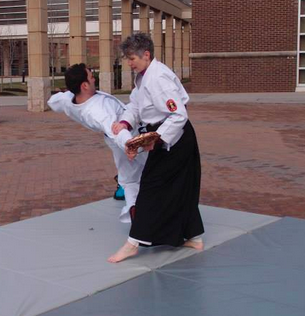
Kokikai Aikido: Defense Against Handbag-Snatch In an earlier post I looked at some reasons why people commonly think that Aikido, specifically Kokikai Aikido, isn't effective as self-defense. Aikido isn't practiced in the way that most martial arts are, teaching strikes and counterstrikes. We choose a fairly small number of basic attack types (punches, grabs, strikes, kicks) and we learn defenses against them. We also learn to defend against more than one person simultaneously - this is very unusual in the martial arts, yet it is more common in a street situation. You Need to Practice For Years Before It's Effective...Right? Wrong. I teach 90-minute seminars that provide effective concepts that people can walk away with and practice their whole lives (hint: it's the four basic principles !) There are many, many stories of Kokikai students, even people with 6-8 weeks of experience, defending themselves against very real attacks. Those I know of include wom...

Is Kokikai Aikido Effective as Self-Defense? (Part I)

Image
I'm always a bit taken aback when people ask this question, especially when they have practiced for a while. I guess I thought it was obvious: Kokikai Aikido is an Effective Form of Self-Defense I can see why some people might be confused. Why People Might Think Kokikai Aikido Isn't Self-Defense When we train, we treat each other with respect and make sure not to hurt each other We learn ways for the attacker to roll/fall out of each technique safely  We don't counterstrike We spend time on techniques that "could never work on the street" We practice defenses against attacks that "don't seem realistic," like being grabbed, or being hit on the head with someone's hand We don't practice at "street speed" We don't often practice defense against "realistic" attacks like kicks, backfists, uppercuts When Sensei teaches, he calls up high-ranking students, has them attack each other, and shows that neither on...

The Bundle of Bamboo

Image
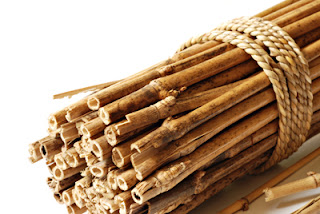
When I teach Kokikai Aikido I am constantly reminding students to slow down. "Metronome 40!" I say, like my old piano teacher who insisted that I practiced at the slowest possible setting of the metronome. I stop students as soon as I see that nage is using force or muscle. And as soon as I turn my back I know they're ramping it up again, to what they feel is "street speed." I can empathize with students who are afraid what they're learning won't be effective in a real-life self-defense situation. It doesn't seem intuitive: practicing in what seems like slow motion, paying attention to every shift of the hips, every turn of the wrist, even where your eyes are focused! Don't we need to practice in a more realistic way, especially at a more realistic speed? The short answer is, no. As Maruyama Sensei says, if you practice "junk" 10,000 times, you'll be really good at...junk. Practicing correctly is far more important than pract...

Misconceptions about Aikido

Image
When I mention to others that I teach aikido I get a variety of reactions, most of which are based on misconceptions. Some seem very confused, as if they can't put this idea together with the person they know. Perhaps it's because most people think of martial artists as young, muscular, and male, and I am none of these. Yet I have been practicing Kokikai Aikido for over 16 years and have been teaching for 8 years. Misconception 1 . I bet you could kick my ass. Reality: It would never occur to me. In practicing aikido I have learned not to react to anything that is not a threat. Misconception 2 . It doesn't make sense for a person who is committed to more peaceful interaction to be involved in a martial art. Reality:  Aikido is an ethical form of self-defense. In Kokikai Aikido, we practice that the greater the threat, the more we relax. This enables us an infinite amount of flexibility, even right in the middle of the response to an attack. I've heard this story...

How to tie your shoes

Image
My cousin Michael taught me how to tie my shoes. The thing is, he taught me about 3 years ago. He noticed that the bow on my shoelaces was vertical, not horizontal. He pointed out that this meant I was tying a granny knot , not a square knot. "Who cares?" I asked. "Do your shoelaces come untied all the time?" "Well, yes, but I thought everyone's did." Not so, apparently. He showed me the simple trick to fix it, which is that when you cross the laces over each other the first time, just switch the way you usually cross them. Then you do the loops (some people call these the "bunny ears") the same way as normal. Voila! Perfect shoelaces that don't come untied! (Well, not nearly so easily, anyway.) What's my point? Always keep an open mind. After all, I thought I already knew how to tie my shoes.