Posts

The Stories We Tell...

The stories we tell ourselves about events in our lives profoundly affect our relationships. Consider these two remarks overheard by a mother and her son: Son: "I spent an entire day on the telephone with airlines rebooking a flight so my mother could get home in time for a New Years Eve party." Mother: "I was able to get an earlier flight, but I had to pay more money."

When the dog bites...

Image
Julie Andrews' recipe for difficult times is to think of her favorite things . You may prefer to listen to Coltrane's version of the tune. But the most powerful way to alter your mood when you're anxious, frantic, worried, sleepless, angry or generally out of control is to alter your breathing. The next time you want to improve your mood, try slowing your breathing down, making your inhalations and exhalations as long and complete as you can without strain for, say, ten minutes. This simple alteration of your body, that you control, can change your mind. Its simple, free, and can be done by just about anyone, just about anywhere!

11 things to let go of in 2011

Image
I heard a great idea today: for the new year, what are 11 things you can let go of? How many of us stop to think about how our desires (or...shall we call them...cravings) limit us? I am sure I'd have saved enough to retire ten years early, if it weren't for the many needless items I have bought over the course of time. The problem is, everything we buy needs to be cared for in some way: kept clean; repaired; batteries charged; tuned, played, or practiced upon (in the case of my many musical instruments); read (books); understood (computers, software, smartphones!). Even throwing things away becomes problematic:  I try not to throw things in the trash unless they can't be recycled, sold, or freecycled . What freedom we would have, if we could let go of the desire for all this stuff! What other stuff can I let go of? The need to "be good" at stuff? Judging others? Judging myself? The need to be at the center of my personal cosmology?  It won't take me lon...

Letting go of fear

Thought for the day: what would it feel like to be relieved of fear? How much fear is bound up in our thoughts, emotions, physical being? I lay on my back for 10 minutes and imagined what my body would feel like if I had no fear. What would my muscles feel like? Hips, shoulders, neck, feet? How would I walk? How would I stand? How would my internal organs feel? How would I relate to others? How would I approach people at parties? In the grocery store? While driving? In business meetings? If your thoughts indeed become your character I want to think about this some more...

Watch your thoughts...

Image
When I read about the Buddhist idea of karma , I had no problem understanding the importance of speaking and acting ethically (or, in terms of the " Eightfold path ," engaging in "right speech" and "right action"). The consequences of our actions ripple out in every direction, in ways that we can't know or even imagine. Ultimately, if you believe that everything living is connected in some way, then you understand that when you hurt others, you hurt yourself. However, I'm sure I'm not the only person who has had difficulty with the concept of "right intention." How can our thoughts cause harm? Then I heard a q uote attributed to Frank Outlaw , which I then chased to this quote from the Buddha. I think this provides good motivation for "right intention." The thought manifests as the word; The word manifests as the deed; The deed develops into habit; And habit hardens into character; So watch the thought and its ways ...

Twelve Years

Image
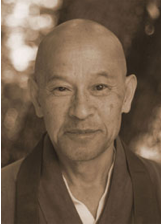
Shunryu Suzuki came to the United States in 1959 at the age of 55. He died in 1971. In those twelve years he completely changed the face of American Zen .

Focus!!!

Image
A lot of things I do seem to share common elements. In playing improvised music, practicing Kokikai aikido and yoga, there is lots of stuff, call it "technique," that must be learned by practicing over and over (maybe not quite 10,000 hours , but it sometimes feels that way). Yet you can practice all those hours and still not tap the richness of the art unless you include something more. This "something more," I think, is developed with a practice that incorporates paying attention. Paying attention means just being aware without judgment. In playing the piano, that means listening with an open heart and mind, and not clinging to anything you just played. Just continuing to listen. And in self-defense, yoga, dancing, art, basketball, marksmanship - although I'm not experienced with all of these, I think there are many similarities. As I get better at paying attention, I can perceive physical tension that's unnecessary and let it go. I can be more aware...