Posts

Showing posts with the label music practice

Admitting Mistakes Opens the Door to Change
Image
At this time of year everyone's thinking about how to "be better" next year. Here's my thought: So many of us want so badly to be better at something (musicians, aikidoka, life partners, parents...) but if we can't look at our mistakes straightforwardly, we can never identify the steps needed to change. If we want to change, the most important step is to admit we made a mistake. I think it's hard for us to admit mistakes because deep down most of us  think we suck . If we admit to a mistake, it just proves the fact. But this doesn't make sense, does it? If I think I'm bad, I should be happy to improve, right? For some reason, though, admitting a particular mistake is much more challenging than carrying the subconscious burden of "not measuring up." It doesn't matter if it's realizing I'm having a hard time with a particular set of chord changes, or admitting that I actually do text while I drive and it's dangerou...

7 Ways for Musicians to Stay Positive about Your Progress

Image
As we achieve a certain level of accomplishment, the details that we focus on in practice become more and more subtle. It can be hard to stay motivated to practice, because it's harder and harder to see results. When I was a kid my piano teacher put gold stars on my music in every lesson. Where are my gold stars now??? I asked my piano teacher, Dave Leonhardt , about this. Here's a list of his ideas and mine. Keep a note pad, and write down something you did well.  Record/videotape yourself. Study your recording. After I get over the initial "cringe factor," recordings are some of my most valuable tools. And if you keep them organized, you can compare old and new, to get perfect snapshot of your progress. At the beginning of your practice session, make a point of noticing how you are playing something you set out to practice. Then notice how you do it at the end.  Take notes of what you're working on every week. If you feel you're not making progre...

Having to Practice vs. Wanting to Practice

Image
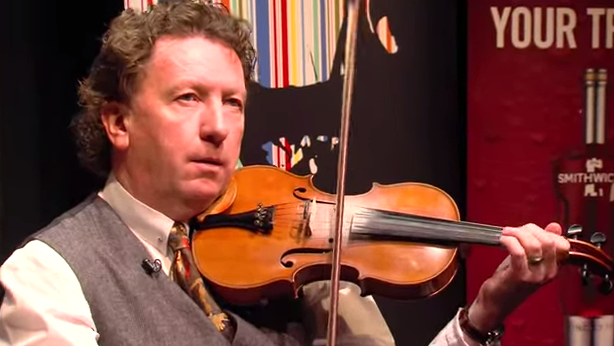
Practice, almost by definition, is something that you have to do regularly. Most of my music teachers (ALL of my music teachers) have told me I need to practice regularly, usually way more than I do. Or they have told me that "professional musicians" practice X hours a day, with the implication that if I ever want to be as good as I aspire to be...well. Thats why I was surprised to hear Frankie Gavin, legendary fiddler and founding member of the group De Danann, saying this in a master class : "Practice for as long as you feel like practicing. If you're really enjoying yourself, time will fly...Practice when you want to. If you feel like you have to practice, it's an awkward one... Decide to practice, yourself...You have to think, 'I know what I'm gonna do, I'm gonna take out the fiddle and play a tune!'"   I like that thought!

Don't Strive to Be the Best

Image
Everyone wants to feel like they are truly unique, different, better, the best , even though, statistically, with more than 314 million people in the U.S. and 7 billion in the world, well, there's just no way.* In my case, I want to be the best musician, the best at aikido, the best mom, the best driver, the best at everything . Maybe not literally, but somehow deep down I am always comparing. If someone else is better, at some level that means I'm just not good enough. And out of 314 million people, there's always someone who's better. Sometimes this means I'm never satisfied and always pushing to be better. Other times it's depressing and makes me want to give up. And from what I've seen, I have a lot of company in looking at things this way. It doesn't help that there's a strong message in our culture that competition is good. Competition supposedly drives us to work harder, be more productive, invent more and accomplish more. But on some...

How Aikido Helps Me Practice...The Piano

Image
A lot of people ask me what aikido has to do with music and here's the essential reason: Musicians, understandably, spend a lot of time thinking about music - learning tunes, listening to their tone, practicing technique. But in aikido I learned that there is a hugely important element to practicing and playing, which is to  practice mind-body coordination . This is nothing esoteric. It has to do with paying attention to your body in a specific way while you are playing. Go to the gym any day and you'll see rows of people on the treadmill, elliptical and stair machines, doing exactly the opposite . Many of us who are trying to learn a physical skill, whether it's a musical chord progression, throwing a perfect curve ball, or a tango "ocho," assume that doing the drills/exercises is primarily a physical activity. In practicing aikido I learned how to coordinate my mind and my body. And I learned why it leads to much better results. To improve mind-body c...

Do You Measure Up?

Image
One of my musician friends is always making sarcastic comments about her own playing: "Of course, when I play with you guys, I can never keep up," or "My embrasure is so terrible, I just don't practice enough," or "That would have been great solo if I had played it in he right key," or "I'll just play quietly sitting next to you, so you won't hear my wrong notes." She constantly compares herself to others and finds herself wanting. The thing is, she's a really good musician! I used to pride myself on my witty sarcasm. I knew that sarcasm can be hurtful, but I thought it was ok as long as I aimed it at myself. I thought it made me seem clever, discerning and appropriately humble to put myself down. Wrong.  My negativity restricted my ability to play well, not to mention my joy in playing. As adult musicians we're all doing this because we love it. Maybe we're getting paid, maybe not, but were definitely not in ...

Precision

Image
I need to work on precision in my playing. Here's what I was told: "When you arpeggiate the chord or play just some of the notes instead of playing all the notes at once, it sounds like a crappy cocktail pianist and makes it obvious that you don't actually know what the voicing is." (I'm sure the actual words were much more friendly, compassionate and gentle but I got that message.) The fact is, I'm sloppy. I'm sloppy in my playing (all instruments) I'm sloppy in my aikido technique I'm sloppy in my speech, both in my enunciation and the words I use I'm a sloppy knitter, cook and gardener, and probably a sloppy driver On the positive side, I'm reasonably accomplished in all these things. Except maybe knitting. So I'm pretty sure that once I shine the beacon of my attention on this issue, if I shine it with some consistency, I will start to see progress in all areas, not just one.  Well, maybe not the knitting.

Consistency

Image
At the beginning of nearly every semester at Rutgers Kokikai Aikido , I have at least one new student who says something like this: "Sensei, I really love aikido, can you tell me how I can practice more often than two days a week? I want to practice every day ." I always tell them that two days a week is optimal, especially considering how much school work they are likely to have. My teachers always said that two days a week was just enough for people who have a "life in the world," whether it's work, school, or taking care of family. I have heard that the cheetah is the fastest animal on land at 113km/hr, but cheetahs can only maintain top speed for short bursts. A slower animal with staying power can overtake a cheetah. There are plenty of martial arts stories about students who are in a hurry to become masterful, and the moral is always the same: there are no shortcuts and consistency is key to mastery . If the student is insisten...