Posts

Showing posts with the label Shuji Maruyama Sensei

Most Relaxed Smile

Image
Recently among a group of instructors, Sensei talked about the importance of a relaxed face with a slight smile. He had each of us try it by smiling normally, and then relaxing the smile into one that is almost imperceptible. I have written about this smile before in the post, The Mona Lisa Smile . This " tiny bud of a smile ," as Thich Nhat Hanh describes it, is something Sensei taught me in 2001. He imitated the face I make when I am concentrating, making his lips like a closed purse. "Looks like an old lady!" he said. At the time I was in my early 40s and did not want to think of myself as an old lady! "Who else would tell you this?" he said, "Not even your mother!" He was right. I've spent the last 13 years working on this smile. At first just when I am relaxed, working to get it just right. Then I worked on achieving it when I'm focused: at work, exercising, playing an instrument, practicing aikido (the hardest one). Focu...

I Can

Image
Of the four principles of Kokikai Aikido, the one I have most difficulty explaining is Positive Mind. It's hard to grasp how changing your mind can affect your physical ability. Scientists concluded way back in the 19th century that the structure of the brain is fixed after childhood, and the idea is so  normative in our culture that we don't even realize it's a belief; it's just the way it is. As an instructor I'm aware that I risk my students thinking of me as a flaky New Age thinker by proposing Positive Mind as an essential part of our practice. It is helpful when I can back up my assertions with scientific results. Recently in a class at the YWCA Princeton , Maruyama Sensei said that thinking "I Can" has a physical effect on the brain, helping make your brain more organized. He may have been referring to a recent study from a group of Japanese researchers  showing that praise following motor training directly facilitates the consolidation of...

Half Power vs. Full Power

Last week I attended a class with Kokikai Aikido founder Shuji Maruyama Sensei . I'm still absorbing some of the ideas Sensei gave us to improve our practice. This particular idea sounds like it's specific to aikido technique, but I think it applies to people who don't practice aikido, too. We practice an exercise called zengo undo , where we raise our arms as if to respond to an overhead attack, and then turn 180 degrees and do the same - as if we had attackers both in front and behind. The challenge of the exercise is to remain centered and calm while changing directions very quickly. Sensei's point was that when we turn from one direction to the other, we need to shift our focus 100%. If we are still thinking about what just happened, or anticipating what's about to happen, we have only half of our power. This sounds very simple, but it's difficult to practice in aikido. It's even harder to practice in daily life. 

Downset, not Upset

Image
Last week I attended a class at Princeton Kokikai Aikido with Shuji Maruyama Sensei, the founder of Kokikai Aikido . He said that when we practice aikido we should focus on being "downset," not "upset."  "Downset" isn't in any English or Japanese dictionaries, but it's a fantastic idea. We become upset when encountering something threatening, unusual or uncomfortable. But what happens if we try to become "downset" instead? What is "downset?" In Kokikai we focus on these four basic principles to develop greater strength and control: Keep One Point to Develop Calmness Relax Progressively Correct Posture (in Everything) Develop Your Positive Mind The more you use all four principles together, the more you can be "downset." It's worth mentioning that "downset" doesn't refer to being heavy or unable to move, in fact, you should have more control of whether you move or don't move. Wh...

Calm Face

Image
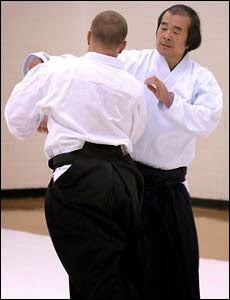
I am often tasked with going through the photos of Kokikai Aikido winter and summer camps  to find a dramatic one to use on the t-shirt. It's incredibly frustrating, because the more intense the throw, the more calm Sensei's face is. To most observers it would seem like nothing's really happening.  Sensei refers to this when he says, "Looks real: fake. Looks fake: real!"  It may be great for aikido, but it doesnt make for a very exciting t-shirt! I learned a lesson several years ago when a good photographer took photos during my test. Comparing the photos of myself to photos of Sensei, the difference was obvious. In every case, Sensei was upright, his body looked controlled and collected, and above all, amazingly soft and relaxed, at every point during the throw. As in aikido, so it is in life: the more chaos that comes our way, the more we need to train ourselves to relax, stay calm, keep centered, stay focused and have positive mind.