A blog about achieving mastery. Written by a musician and martial arts instructor, it draws ideas from both disciplines. "Kotsu kotsu" is a Japanese phrase can be translated as "step by step," or as experiencing each moment.
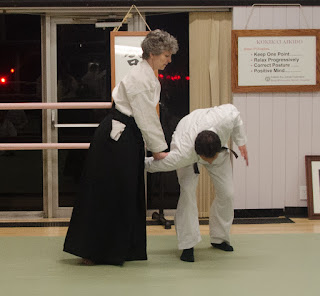
After taking her first classes with Rutgers Kokikai Aikido Club, a student asked, "Do you do conditioning exercises, like pushups, leg lifts or squats?" She seemed surprised when I said, "No," since strength and aerobic conditioning exercises are part of the warmup drills for most martial arts. Here's why we don't spend time on "conditioning" and "muscle building" exercises in Kokikai Aikido classes: Kokikai Aikido training is highly-specialized . Black belt instructors have typically trained for a minimum of seven years to gain the level of experience needed to teach. If they have advanced black belt degrees (which many do), they may have been training for 10, 15, even 35 years! (In contrast, you can get a certificate as a fitness trainer in a few days or weeks.) We try to make best use the limited time in class, teaching things that require this expertise. The "strength" that we develop from practicing Kokikai Aikido ...
I've practiced the same martial art, Kokikai Aikido , for over 22 years. Even though I've written elsewhere about how to choose the best martial art , I've never tried another aikido style, or even another martial art. I lucked out and landed in a practice that's perfect for me, with a highly effective curriculum, a world-class founder, amazing senior instructors, and I never saw the need to look elsewhere. Even so, it's always bothered me that a lot of other martial artists consider aikido to be a "joke." I can't speak for other styles, but there's no question in my mind that Kokikai Aikido is effective. Our founder, Shuji Maruyama Sensei , personifies everything that aikido ever claimed to do or be: small of stature, powerful, effective, without harm to opponent. But he's always been reticent about blowing his own horn or putting video of himself on YouTube, so I can see why most people don't know much about him or his style. So, ...
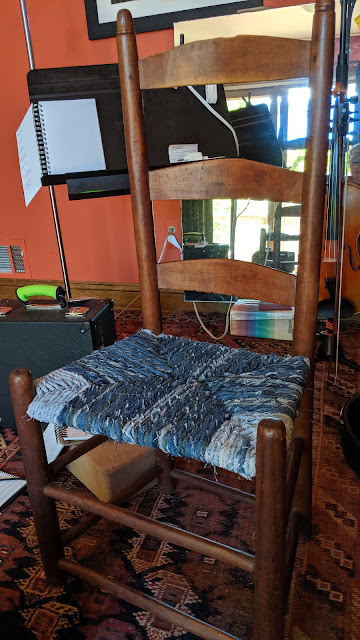
I used the technique for weaving a rush chair seat to make a chair seat using old jeans. The antique ladderback chair is just the right height for me to practice my Québécois button accordion. Fabric Choice Although at first I considered using t-shirt strips (also called tarn), I decided to jeans because denim is stronger and not stretchy. I had some old heavy linen fabric that would have done the trick, too, but I didn't have enough for the whole chair with either linen or jeans. I decided not to mix them, at least not for my first chair. I was advised, (correctly!) by other crafters, that all I had to do was out the word out, and I’d get donations. I sent out 4 emails and literally went shopping and there were two pairs of jeans on my doorstep. I had five more pairs by the weekend. (Now I need another chair!) Some Pointers Before I describe the process, here are some pointers. I don't recommend doing this with a stretchy fabric. Therefore, if you use jeans, avo...

Comments
Post a Comment